

Segment videos
The platform partitions videos into labeled, timestamped segments. Define the types of segments you want to detect and the fields you want to extract. The platform identifies segment boundaries and returns custom metadata for each segment in JSON format. For details on segment definitions, fields, and best practices, see the Segment videos guide.
The page uses a two-panel layout. Select a video, define your segments, and configure parameters in the left panel. Results appear in the right panel.
Get started
When you open the Segment page, you can start in one of the following ways:
- Segment your own video: In the left panel, select a video, choose a template, and run segmentation. See the Procedure section below for the full steps.
- Resume a previous task: In the right panel, select the History tab and choose a past task to load its results.
- Try an example: In the right panel, select the Examples tab and choose a pre-built example. The example populates a video and segment definition for you and runs segmentation automatically. After the results appear, you can edit the definition and rerun segmentation.
Procedure
-
In the left panel, select the video preview area to choose a video that you’ve already uploaded, or upload a new video directly from the dialog.
-
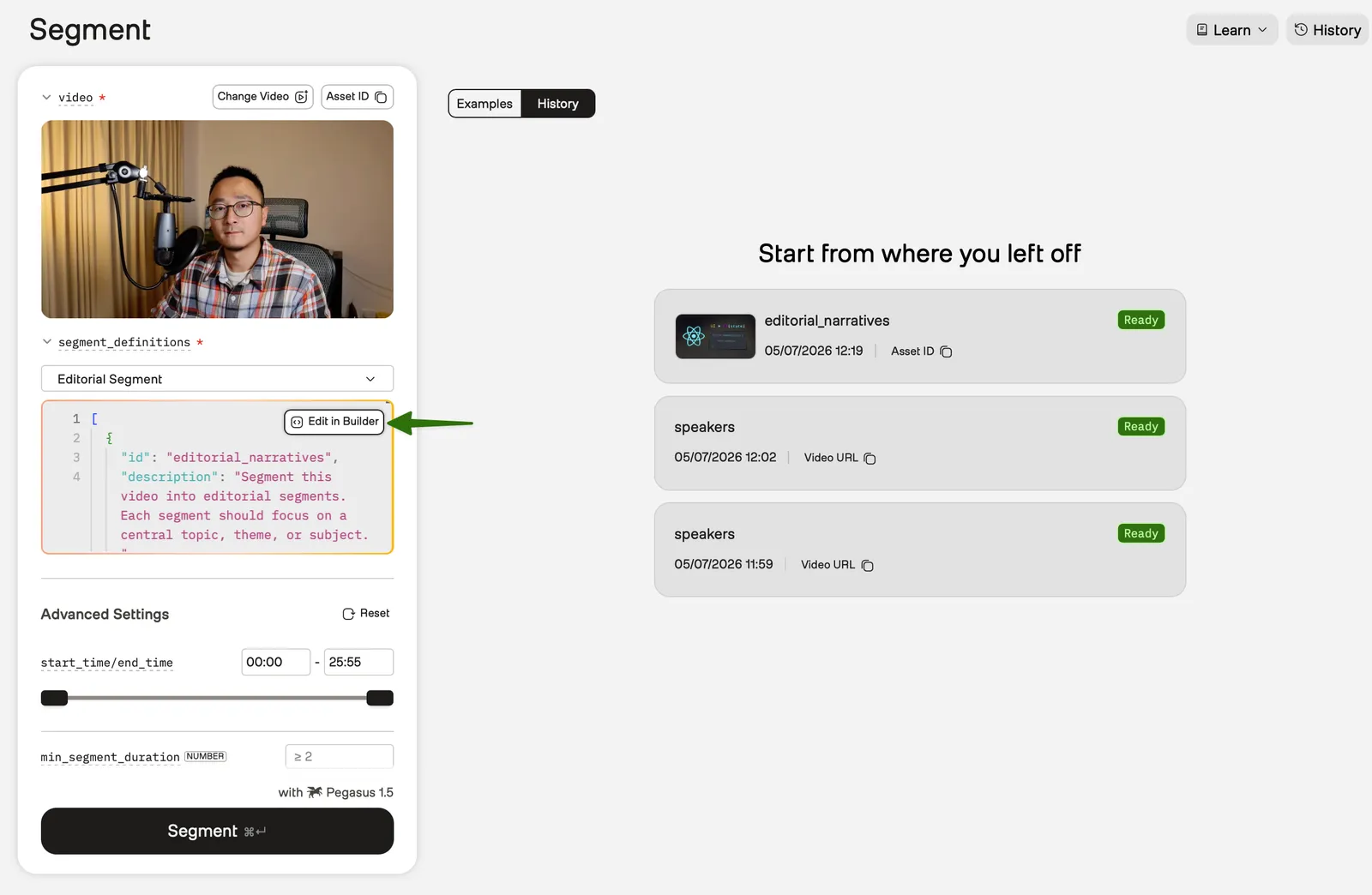
Define your segments. Under segment_definitions, select a template or choose Write My Own to start from scratch with an empty segment definition.
-
(Optional) To customize the definition, select the Edit in Builder button.
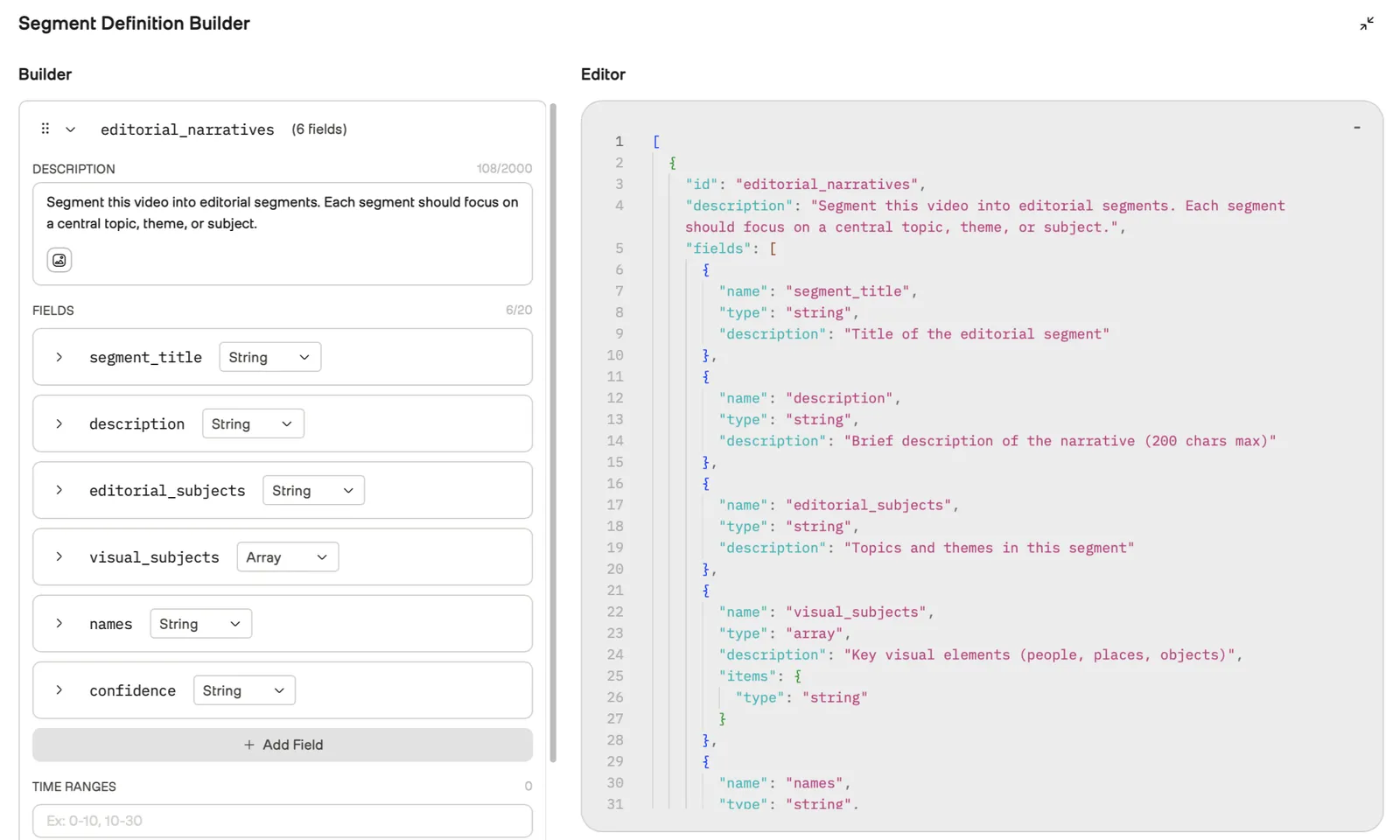
The Segment Definition Builder modal opens with two panels. Define your segment in the Builder panel (visual interface) or the Editor panel (raw JSON). Changes in either panel are reflected immediately in the other.
In the Segment Definition Builder, you can:
- Edit the segment description.
- Add, rename, or remove fields.
- Specify time ranges to limit segmentation to specific parts of the video.
- Add more segment definitions.
-
(Optional) Adjust the parameters under Advanced Settings. To reset all parameters to their default values, select the Reset button.
-
Select the Segment button. The platform displays progress messages while processing. You can leave the page and return later to see the results.
View results
Results appear in the right panel. Select the Visual or JSON tab to switch between views.
Visual tab
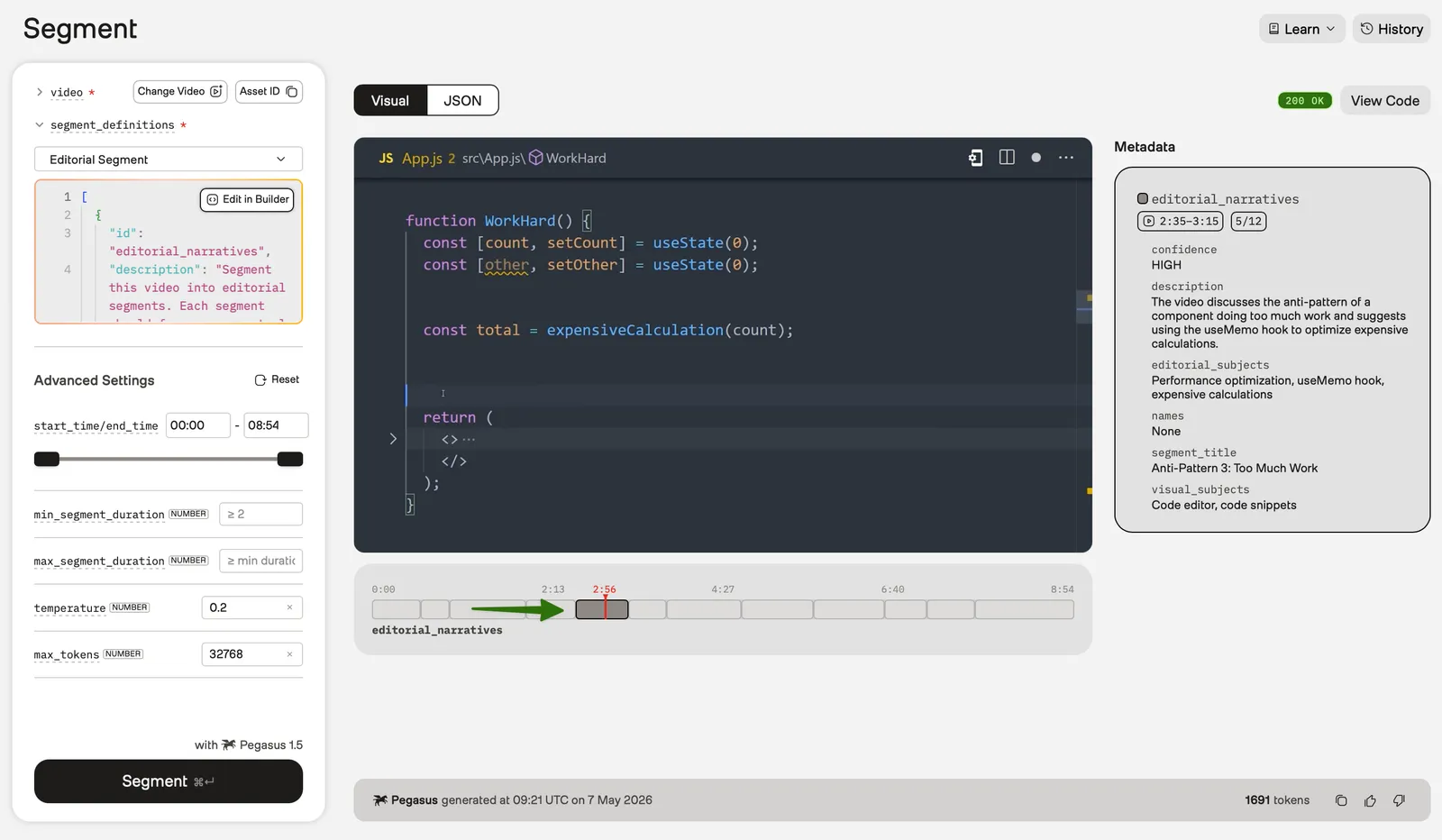
The Visual tab shows a video player, a segment timeline, and a metadata panel.
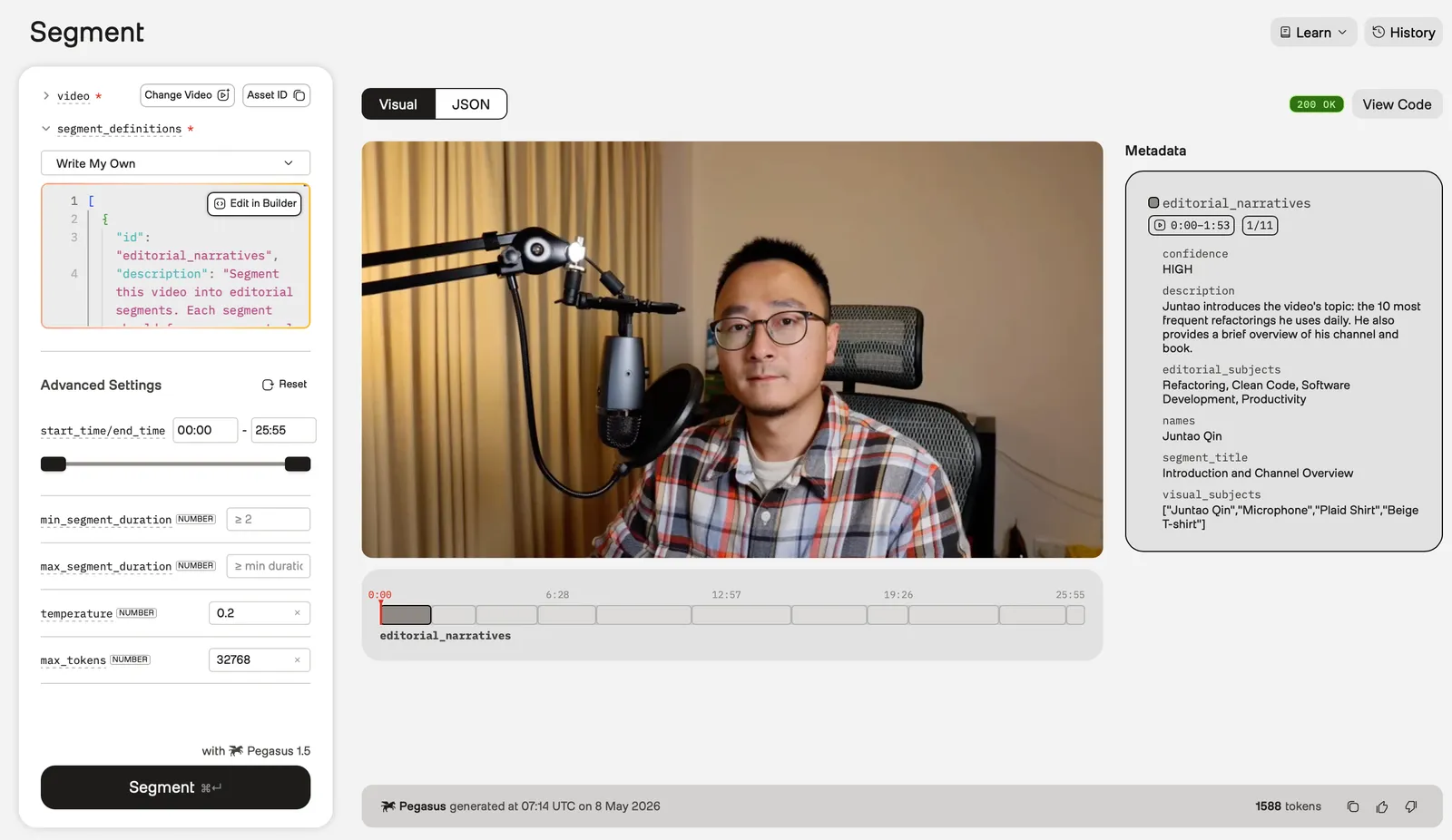
- Video player: Plays the selected video. Navigates to the corresponding segment when you select a segment on the timeline.
- Segment timeline: Displays segments as labeled blocks on a horizontal bar. Hover over a segment to see its time range. Select a segment to play it and view its metadata.
- Metadata panel: Shows the extracted fields for the selected segment, including the segment definition name, a timestamp badge, and a segment counter (Example: “7/12”).
JSON tab
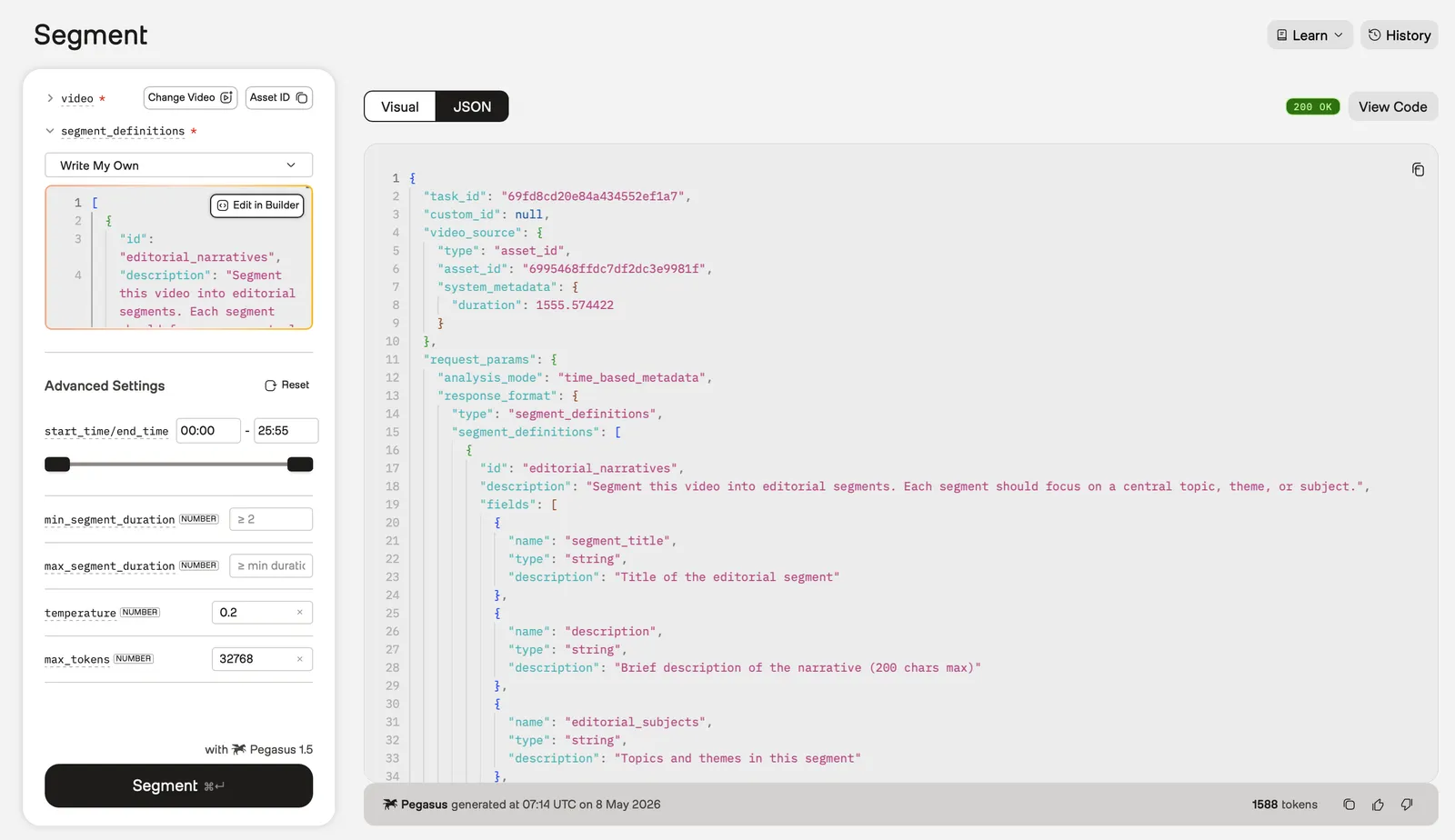
The JSON tab shows the raw JSON response. This includes the segment definition schema, all detected segments with timestamps, and the extracted metadata for each segment.
Work with results
Play a specific segment
Select a segment on the timeline to play that portion of the video. The metadata panel updates to show the fields for the selected segment.
View the code snippet
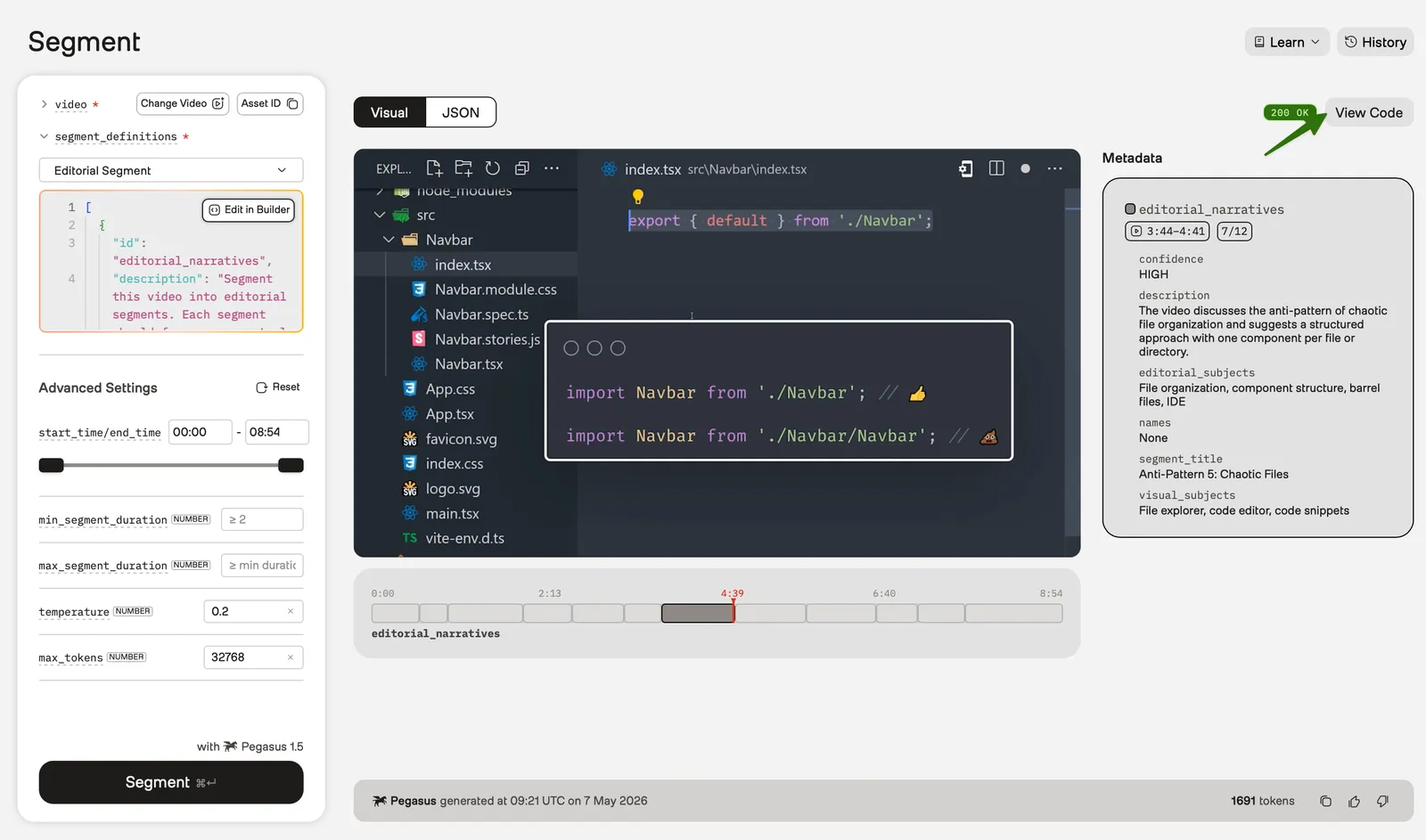
Select the View Code button to see the request as cURL, Python, or JavaScript. Copy and paste the snippet into your application.
Adjust your segment definitions
To change your segment definitions, select a different template from the segment_definitions dropdown or select the Edit in Builder button to modify the definition directly. Then select the Segment button to rerun the segmentation.